Neapolitan icons: your first glimpse of the city
There are places in Naples that are more than mere destinations.
They are recognizable landmarks, collective memories, beating hearts that reveal the city’s deepest soul. Some are known worldwide, others are revealed only to those who know how to look.
But they all speak of the same thing: Naples’ identity.

The city's unmistakable silhouette
One glance is enough to know where you are. Mount Vesuvius, majestic and silent, dominates the scene and watches over everything. At its feet, Castel dell’Ovo seems to float on the water like an ancient legend. A little further on, Piazza del Plebiscito, with its neoclassical curves and the grandeur of the Royal Palace, defines the ceremonial heart of the city.
These places are not just postcard backdrops—they are mental images, powerful symbols that condense centuries of history and imagination.

Sites of popular devotion and living spirituality
In Naples, the sacred is everywhere. The Sansevero Chapel, with its Veiled Christ that seems to breathe, is a temple of art and mystery. But equally meaningful are the places lived daily by Neapolitans: the Cathedral of San Gennaro, where the miracle that renews the bond between the city and its patron saint takes place, or the Sanctuary of Santa Maria Francesca, in the Quartieri Spagnoli, where people go to pray for a child or a blessing.

Urban spaces that speak of living Naples
Then there is a Naples made of squares, markets, and alleys: places where identity is not narrated but lived.
Spaccanapoli, slicing through the historic center with its perfect line.
Piazza Bellini, with Greek ruins and vibrant nightlife.
Via Toledo, a historic artery connecting center and people, past and present.

Popular districts: identity in everyday gestures
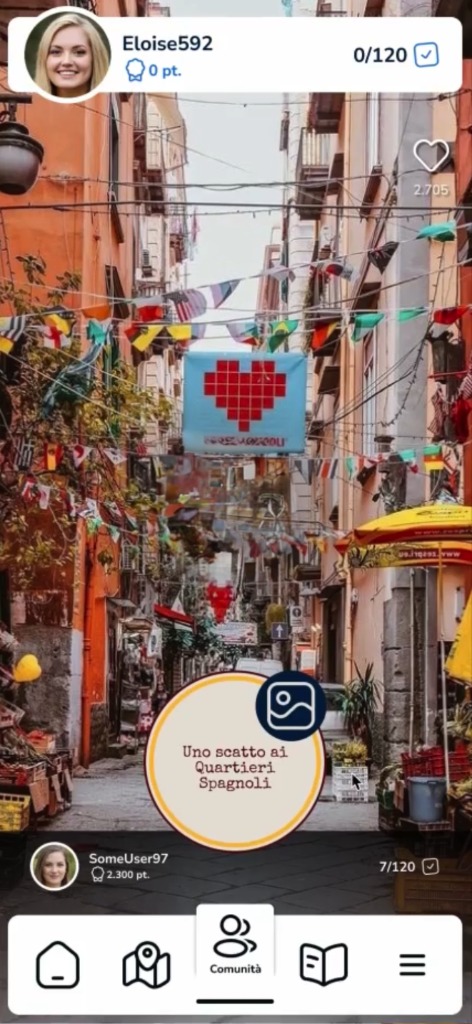
Naples is made of many souls living together in a precarious but vibrant balance. In neighborhoods like Sanità, Forcella, the Quartieri Spagnoli, Materdei, Vergini and Stella popular identity is expressed through everyday life: in markets, courtyards, and shared rituals. Here you feel a raw energy made of strong ties and handed-down stories. From the Maradona murals in Forcella to the votive shrines of the Sanità, from the climbs of Materdei to the voices filling Via Toledo, these districts are the living heart of the city, where time intertwines with memory, and tradition meets the present.

Architecture that tells of power, art, and culture
The Castles of Naples—Castel Nuovo, Castel dell’Ovo, Castel Sant’Elmo—are more than defensive structures: they are witnesses to the many cities Naples has been. So are the great cultural venues: the San Carlo Theatre, the oldest still in operation in Europe, and the National Archaeological Museum, a treasure trove of Pompeii and Naples itself.

Where identity becomes landscape
And then there are spaces that represent Naples in the collective imagination.
The seafront promenade of Via Caracciolo, with fishermen at the Borgo Marinari and the scent of the sea breeze.
The Cemetery of the Fontanelle, where skulls speak and the faithful adopt souls.
The Galleria Umberto I, where shopping, theatre, and the glass sky of elegant Naples intersect.

Unmissable symbolic places
- Vesuvius and Castel dell’Ovo: the visual icon of Naples
- Piazza del Plebiscito and Royal Palace: the historical-institutional heart
- Sansevero Chapel and Cathedral of San Gennaro: art and devotion
- Spaccanapoli and Via Toledo: vivid and dynamic Naples
- Popular neighborhoods: Sanità, Forcella, Quartieri Spagnoli, Materdei, Vergini and Stella
- Historic castles and theatres: fortresses and beauty
- National Archaeological Museum: deep roots
- Cemetery of the Fontanelle: spirituality and mystery
- Seafront and Borgo Marinari: the face open to the sea
Visiting these places means exploring Naples with new eyes. They are not just stops—they are identity-rich experiences that reveal who this city truly is: contradictory, vibrant, deeply human.